
Branded Email Shell 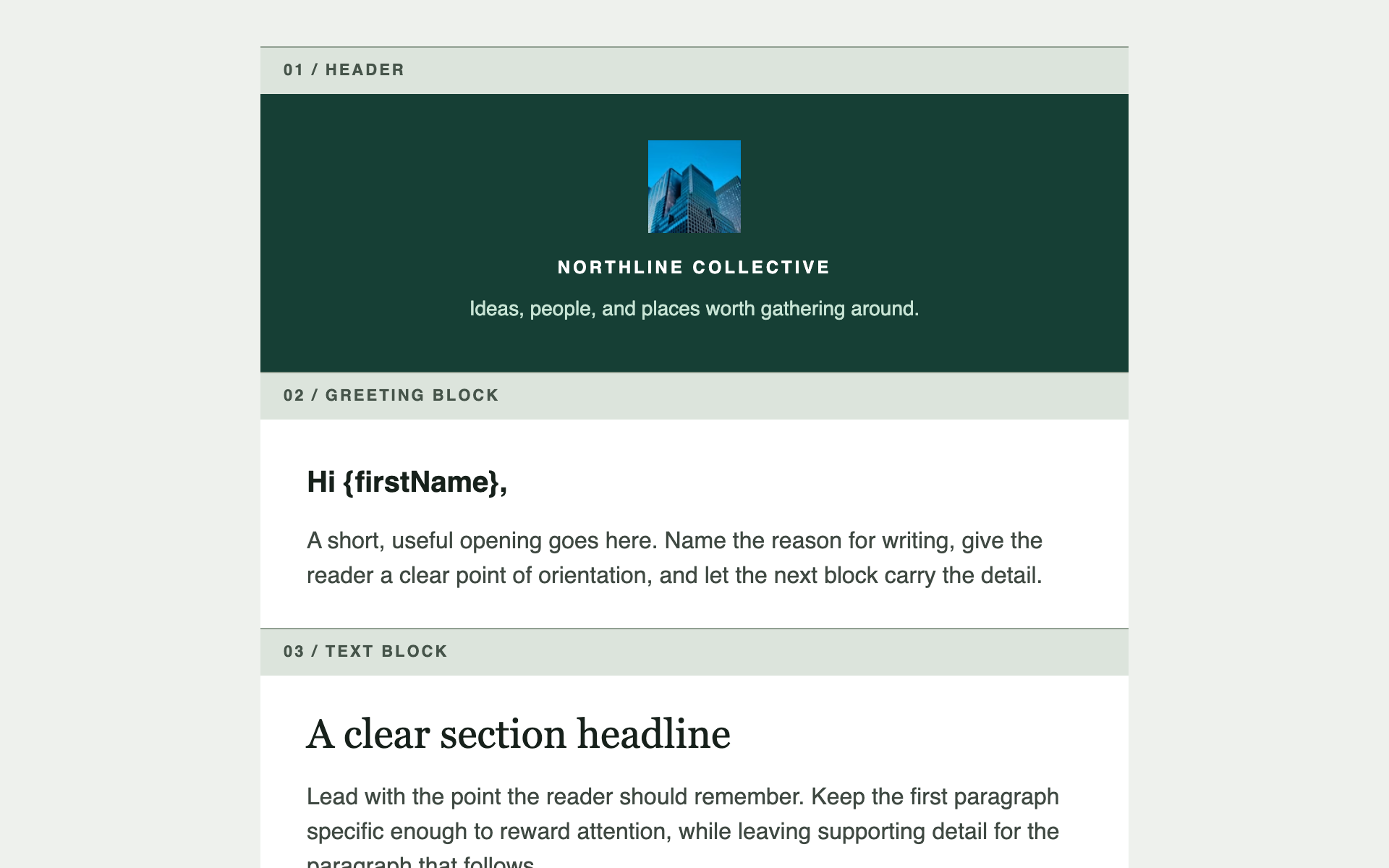
Branded Email Shell
Not one template — a reusable header, footer, and set of content blocks in your brand, which you assemble into any future email. Generate once, use for everything.
Newsletter Prompts
A multi-story newsletter layout with section dividers and read-more links — the workhorse format for a monthly update to clients, portfolio companies, or members.
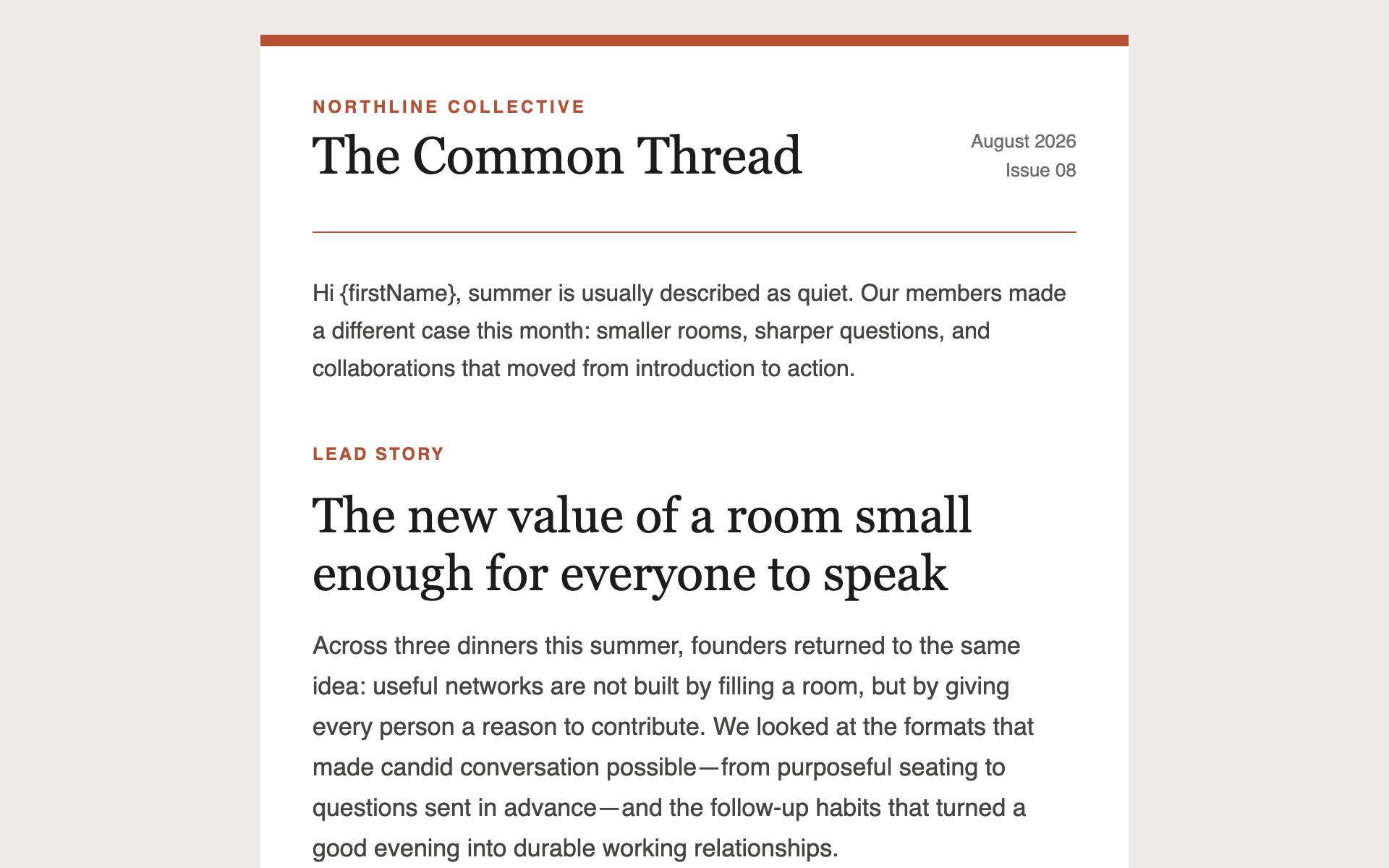
The format most firms reach for first and get wrong most often — too many stories, no hierarchy, and a wall of text nobody scrolls. This one forces a lead story, keeps the rest scannable, and survives having its images blocked.
Works in Gatsby Email Campaigns today. Drops into the Newsletters add-on when it ships.
Create a monthly newsletter email template for [YOUR ORGANISATION], a [describe your firm in one line — e.g. "a venture capital firm writing to founders and LPs"].

Structure, in order:

1. A masthead with the newsletter name and issue date. Text only — assume no logo image loads.
2. A short editor's note, two or three sentences, opening with "Hi {firstName},".
3. ONE lead story: headline, a 60–80 word summary, and a "Read more" link.
4. Two or three secondary stories, visibly smaller than the lead: headline, one sentence, link. Separate them with hairline rules rather than boxes.
5. An optional single-line "What's next" mentioning an upcoming event. Link it with a plain https:// URL I will paste in — a newsletter has no event attached, so an event merge tag would render as an empty string and leave a dead link.
6. A footer with the organisation name only. Do NOT add an unsubscribe link or a mailing address; Gatsby appends a locked footer carrying both.

Design direction: [editorial and restrained / warm and personal / clean and corporate]. Use a single accent colour, [#HEX], for links and rules only. Everything else greyscale. Generous whitespace. This should read like a well-made trade publication, not a marketing blast.

Make the hierarchy unmistakable — the lead story should be roughly twice the visual weight of the secondary ones. Someone skimming for four seconds should come away knowing the lead story.

Use realistic placeholder copy about [YOUR SUBJECT AREA] so I can see how real text sits in the layout. Don't use lorem ipsum.

Technical requirements — these are not stylistic preferences, they are what makes the email render correctly in Outlook, Gmail, and Apple Mail:

- Output ONE self-contained .html file. No external stylesheets, no external fonts, no JavaScript, no web fonts via @font-face.
- Use table-based layout only. No flexbox, no CSS grid, no position: absolute. Outlook's rendering engine ignores all three.
- Put all CSS inline as style attributes on elements. A <style> block in <head> may be stripped; anything you rely on must be inline.
- Maximum content width 600px, centred, inside a full-width wrapper table with an explicit background colour.
- Use only web-safe font stacks — Helvetica, Arial, Georgia, or system-ui — each with fallbacks. Never load a font.
- Set an explicit background-color AND color on every table cell containing text. Dark-mode clients invert unstyled backgrounds and will destroy your contrast.
- Every image needs a descriptive alt attribute and an absolute https:// URL. Many clients block images by default, so the email must still make sense with every image missing. Do not embed images as data: URIs — Gatsby strips them.
- Buttons are a table cell with a background colour and padding wrapping an <a>, never a styled <button> element.
- Minimum 14px body text and 44px tall tap targets. Most of these are read on a phone.
- Gatsby removes anything outside its allowlist before sending: no <script>, <iframe>, <form>, <object> or <embed>, no on* handlers, and no id attributes. Links must be http, https or mailto. Stick to tables, text, images and inline styles and none of this will bite.

Gatsby-specific — this is a NEWSLETTER, sent to subscribers on a schedule. There is no event attached to it.

- Personalisation tokens use SINGLE curly braces. These are the ONLY tokens that exist here. Do not invent others:

  {firstName} {lastName} {nickname} {email}
  {newsletterName} {companyLegalName}

  Custom fields are also available as {field_YourFieldName} — letters, digits and underscores only. Only use one where every subscriber has a value.

- Any other brace token is replaced with an EMPTY STRING when the email sends. That includes anything event-related — there is no RSVP link, no event date, no venue, because a newsletter is not attached to an event. If the content calls for a link to an event, use a plain https:// URL and tell me to paste the real one in.

- Three ways to break a token that all fail quietly:
  - {{firstName}} — doubled braces are an escape. The recipient sees the literal text {firstName}.
  - { firstName } — padding stops the lookup. The recipient sees the braces.
  - A misspelled name renders as nothing at all.
  Gatsby's composer does warn about all three before you send, with line numbers — but the warnings are advisory and will not stop a send.

- DO NOT add an unsubscribe link or a physical mailing address, and note there is no token for either. Gatsby appends a locked footer carrying both to every newsletter automatically, so a copy in the body is duplicate legal text. If the structure above asks for a footer, give it the organisation name only.

- Do not add your own tracking pixels, open-tracking images, or link-wrapping. Gatsby handles tracking. Not one template — a reusable header, footer, and set of content blocks in your brand, which you assemble into any future email. Generate once, use for everything.
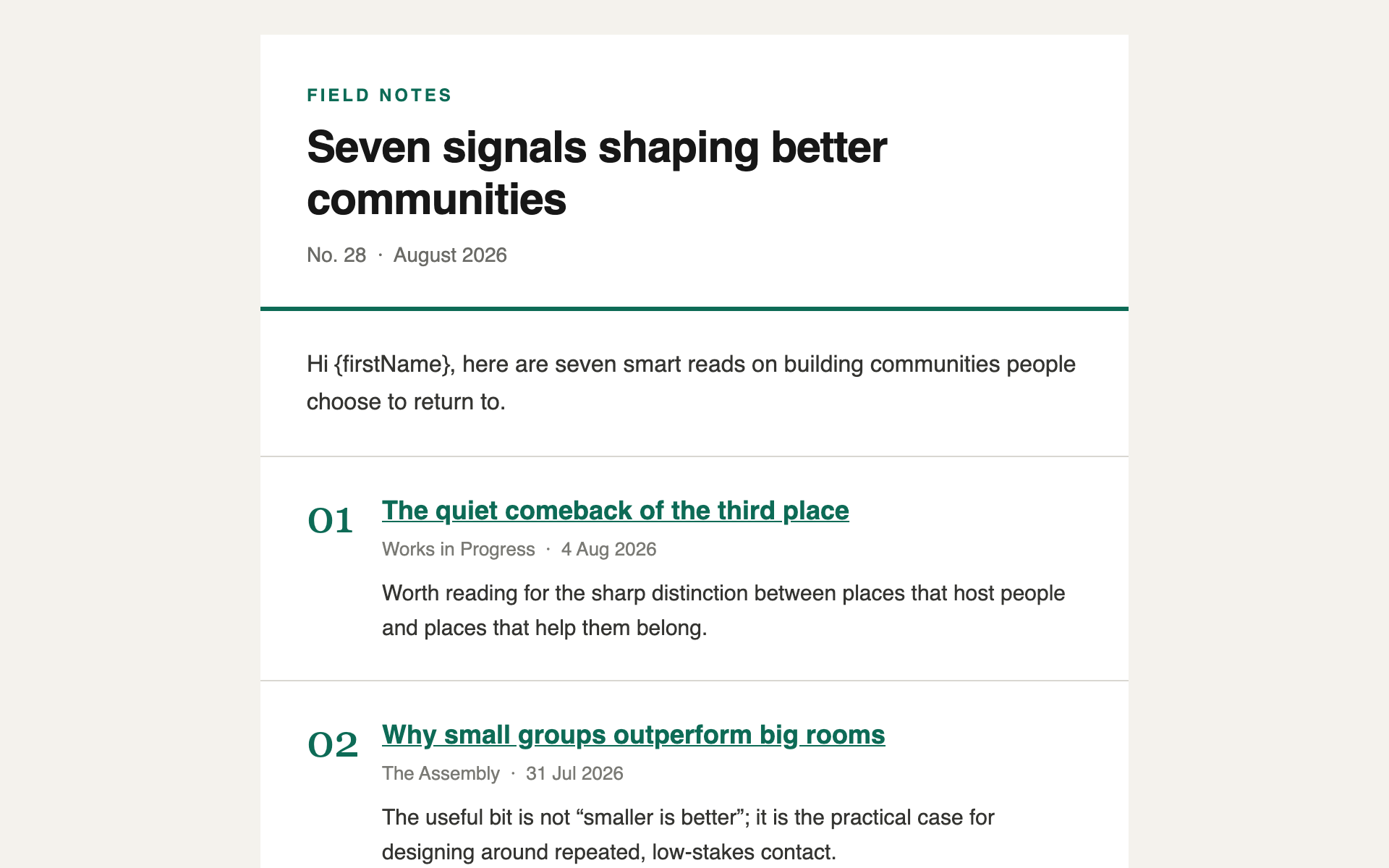
A minimal, typographic digest — a short list of links with one line of commentary each. The format that gets read on a phone in under a minute.
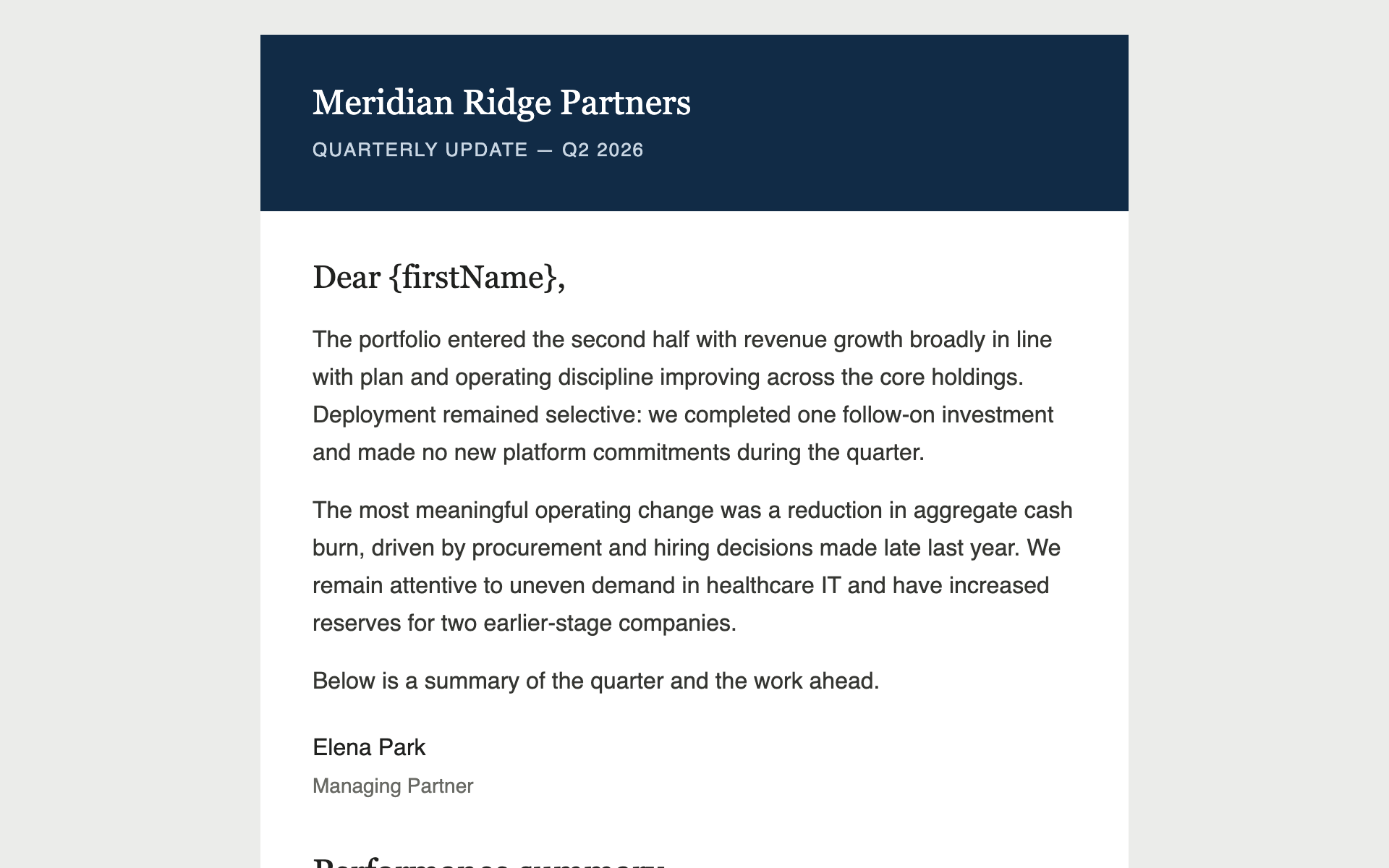
A restrained quarterly update for limited partners or clients — a data table, a chart rendered as an image, and copy that reads as institutional rather than promotional.
Built something like this on Gatsby? We'd like to feature it.